
Patient education · Lipedema
Lipedema in Winnipeg: signs, misdiagnosis, and how compression helps

If your legs ache and feel heavy, bruise at the lightest knock, and won't slim down no matter how carefully you eat or how hard you exercise - you are not imagining it, and it is not a willpower problem. There may be a name for what you're living with: lipedema.
Lipedema affects an estimated 1 in 9 women (around 11%), yet most go years - sometimes decades - without a correct diagnosis. They're told to lose weight. They're told it's just genetics. They're handed a diet and sent home, while the pain and heaviness keep building. This guide explains what lipedema is, how to tell it apart from ordinary weight gain and from lymphedema, and how the right compression - fitted properly - can help you feel better.
The basics
What is lipedema?
Lipedema is a long-term, progressive condition involving an abnormal build-up of fat tissue, almost always in women. The fat collects symmetrically - both legs, hips and buttocks, and sometimes the arms - and it is painful, tender, and bruises easily. Crucially, it does not respond to diet and exercise the way ordinary fat does.

It tends to appear or get worse during times of hormonal change - puberty, pregnancy and menopause - and it often runs in families. That hormonal pattern is one of the biggest clues that you're dealing with lipedema rather than simple weight gain.
Tell them apart
Is it lipedema, weight gain, or lymphedema?
Lipedema is routinely mistaken for two other things: ordinary obesity and lymphedema (swelling caused by a blocked lymphatic system). Getting the label right matters, because the wrong one sends you down the wrong path for years.
| Feature | Lipedema | Weight gain / obesity | Lymphedema |
|---|---|---|---|
| Where it sits | Both legs/arms, evenly | All over the body | Often one limb, uneven |
| Feet & hands | Spared - a "cuff" forms at the ankle or wrist | Affected like the rest of you | Usually swollen too |
| Pain & tenderness | Common - it hurts to press | Not a key feature | More heaviness than tenderness |
| Bruising | Easy and frequent | Not typical | Not typical |
| Diet & exercise | The affected fat barely changes | It responds | Doesn't change it directly |
Here's the hard part: lipedema can exist alongside both. Many women carry extra weight as well, and over time lipedema can begin to involve the lymphatic system - when the two occur together it's called lipo-lymphedema. A quick glance in a rushed appointment almost guarantees it gets missed.
Could this be you?
The signs to look for
- Legs and hips that look much larger than your upper body
- A noticeable "cuff" where the swelling stops at the ankles or wrists
- Tenderness or pain in those areas, especially when pressed
- Easy bruising you can't always explain
- A heavy, aching feeling that gets worse through the day
- Fat that simply won't shift, no matter the diet or training
- A family history of the same body pattern
Lipedema is generally described in three stages, from smooth skin with small nodules you can feel underneath (early), to a more dimpled, uneven surface, to larger tissue changes that can affect mobility. The point of knowing your stage isn't to frighten you — it's that earlier, consistent care changes how things progress.
What helps
How lipedema is managed
There is no cure for lipedema today, but there is a great deal you can do to ease symptoms, protect your mobility, and slow how it progresses. Care is built on a few consistent habits working together:
- Compression therapy Medical-grade garments that support the tissue, ease aching and heaviness, and help manage swelling.
- Manual lymphatic drainage (MLD) A gentle, focused massage that supports lymphatic flow.
- Movement Low-impact and water-based exercise, which is especially kind to tender tissue and joints.
- Anti-inflammatory eating Aimed at lowering inflammation rather than chasing weight loss the affected fat won't give up.
- Skin care Protecting the skin, particularly as the condition progresses.
The detail that matters most
Compression: why the right garment matters more than you'd think
Compression is one of the most effective everyday tools for lipedema. The right garment can take the edge off the daily ache and heaviness, support how you move, and help control swelling. But here's what the internet usually leaves out: the wrong garment can do very little — or even feel worse.

This is exactly why a proper, certified fitting matters: the difference between a garment you grit your teeth through and one that actually helps comes down to the right type, the right pressure, and the right fit for your body.
Manitoba
Getting your compression covered

Medical-grade compression is an investment, and many women don't realise their garments may be covered. Coverage varies by plan, but private insurers commonly look for a diagnosis, a prescription, and evidence that you're using compression as part of ongoing care. For lipedema specifically, custom, flat-knit garments are often the right choice and can be documented as medically necessary - though in some cases an appropriate textured off-the-shelf option, such as capris, leggings or open-toe pantyhose, may also be suitable.
We can help with this
Our team can help you understand your options, prepare the documentation your insurer is likely to ask for, and direct-bill where it's available - so cost is less of a barrier to getting the garment that's actually right for you. Just ask when you book.
Your visit
What to expect when you visit Liberty
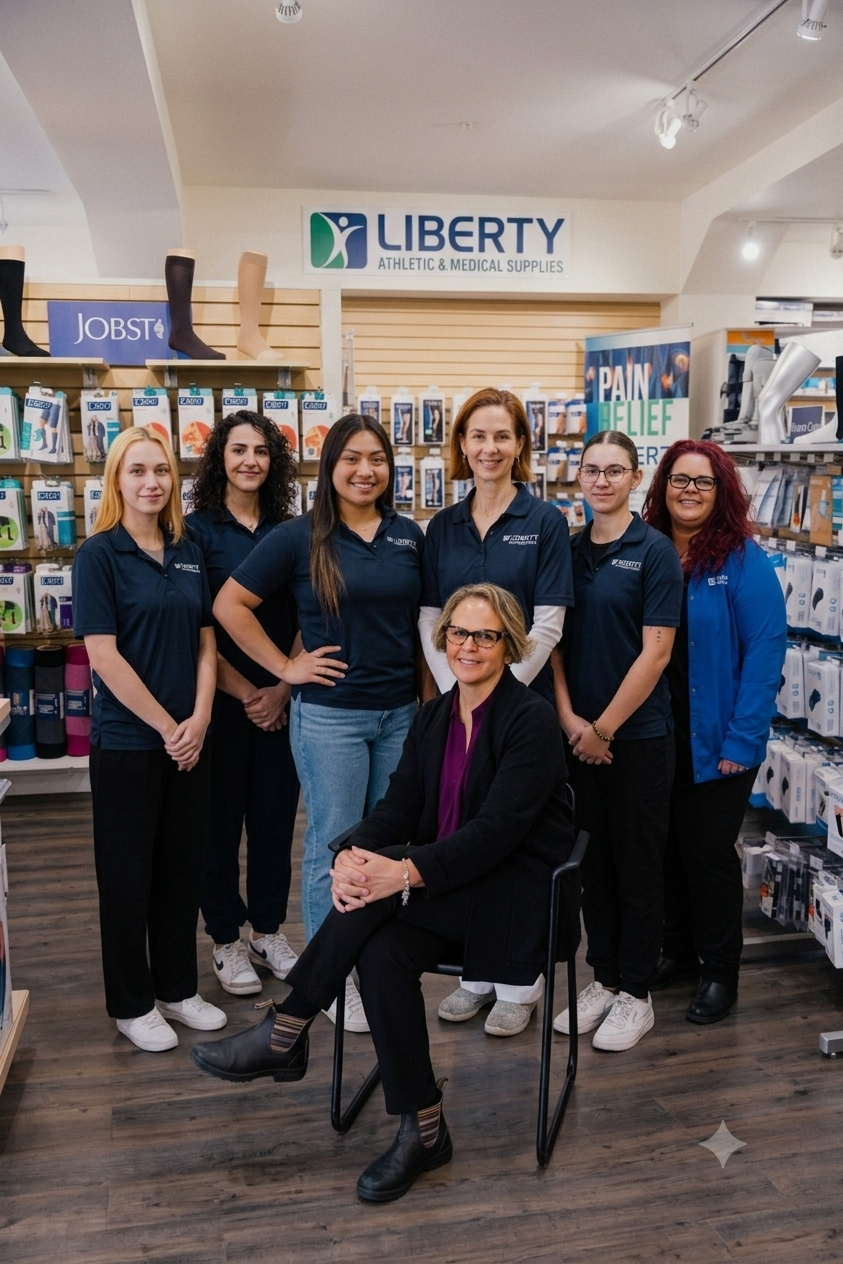
If you've never had a fitting, here's what actually happens. You sit down with a trained fitter - for lipedema and lymphedema, that's Shannon Esau, our Certified Lymphedema Therapist, or certified fitter Rovelyn Domingo. We talk through your symptoms and history, take careful measurements, and recommend the right type, compression level and fit for your body - including flat-knit or custom options where they're the better choice.
Meet Shannon Esau & Rovelyn Domingo - your local fitting team

Most medical supply stores simply sell you a garment. At Liberty, you can sit down with Shannon Esau - a Registered Physiotherapist and Certified Lymphedema Therapist (CLT) with more than 15 years of clinical experience and a guest lecturer at the University of Manitoba. You'll also work with certified fitter Rovelyn Domingo, who is dedicated to providing compassionate care for custom and post-mastectomy garment fittings.
A CLT in a retail setting is genuinely rare in Winnipeg. It means your fitting isn't a guess - it's grounded in real clinical understanding of how lipedema and the lymphatic system behave. That's the difference between a garment you tolerate and one that helps.
Talk to Winnipeg's compression & lymphedema fitting team
Book a consultation and certified fitting - and find out what properly fitted, lipedema-aware compression can do for you.
264 Tache Avenue, Winnipeg · Mon–Fri 10–6 · Sat 10–2
Good to know
Frequently asked questions
Is lipedema the same as being overweight?
No. Lipedema is a disorder of the fat tissue that causes symmetrical, painful, easy-bruising fat — usually in the legs and arms — that doesn't respond to diet and exercise the way ordinary fat does. You can have lipedema at any body size, including a slim upper body with much larger legs.
What's the difference between lipedema and lymphedema?
Lipedema is an abnormal build-up of fat, usually symmetrical and sparing the feet and hands. Lymphedema is swelling from a blocked or damaged lymphatic system, often in one limb and usually involving the foot or hand. They can occur together (lipo-lymphedema).
Can compression cure lipedema?
No treatment cures lipedema. Compression is a core part of managing it - easing pain, heaviness and swelling and supporting mobility - when it's fitted correctly and worn consistently.
What kind of compression is best for lipedema?
Most people with lipedema do best in flat-knit or custom garments rather than standard circular-knit socks, because they accommodate irregular limb shapes. A certified fitting is the only reliable way to know what's right for you.
Does insurance cover compression for lipedema in Manitoba?
It varies by plan. Many private insurers cover medical-grade compression with a diagnosis and prescription. Our team can help with the documentation and direct-bill where it's available - ask when you book.
Do I need a doctor's note or diagnosis first?
For coverage, usually yes. You don't need one to come in and talk to us about your symptoms and options, but a lipedema diagnosis itself is made by a physician. We can point you toward a clinician for assessment.
Sources: Cleveland Clinic; Cleveland Clinic Journal of Medicine (2024); Lipedema Foundation; Lipedema Canada; and peer-reviewed reviews of lipedema diagnosis and management (2024–2025).
This article is for general education and awareness only and is not medical advice, diagnosis, or treatment. Lipedema should be assessed by a qualified healthcare professional. Always consult your provider about your own situation before starting any treatment, including compression. International Lipedema Awareness Day is observed on June 11.
About Liberty
Compression Socks for Travel: What Winnipeg Flyers Should Know Before a Long Trip