
After breast surgery, there are plenty of dates to remember: surgery day, follow-up appointments, dressing changes, treatment schedules and check-ins with your healthcare team.
Then another question often appears:
When can I finally be fitted for a permanent breast prosthesis?
- It sounds as though there should be one simple answer.
- Eight weeks. Ten weeks. Twelve weeks.
- But recovery does not work quite that neatly.
The Canadian Cancer Society says a permanent breast prosthesis can generally be fitted about 8 to 12 weeks after surgery, allowing time for the incision to heal and postoperative swelling to decrease. But that is a general timeframe, not a deadline everyone is expected to meet.
For one person, eight weeks may be appropriate. For another, swelling may still be changing. Someone undergoing radiation treatment may need more time. Another person may simply not feel ready yet.
So instead of asking only:
“Has enough time passed?”
there is a better question:
“Has my body healed enough for a permanent fitting to be useful?”
That difference matters.
Why Healing Matters More Than Counting Weeks
A permanent breast prosthesis is intended to become part of your longer-term wardrobe. It may be worn inside a pocketed mastectomy bra or, depending on the product, used in another way recommended by the manufacturer and fitter.
For that fitting to work well, the fitter needs to understand the shape of your body after the early stages of recovery have settled.
Immediately after surgery, your chest can still be changing.
Swelling may affect circumference. The surgical area may be tender. The chest wall may continue to change as inflammation decreases. Scar tissue and sensitivity can also affect which garments feel comfortable.
This is why CancerCare Manitoba advises allowing the surgical area time to heal before wearing a breast prosthesis and bra, and recommends speaking with your surgeon or healthcare provider if you are uncertain about your healing.
Getting fitted too early does not necessarily mean something dangerous will happen, but it can mean you are trying to select a longer-term product while your measurements are still changing.
A form that appears right today may sit differently once swelling decreases.
Waiting is not about reaching a magical date.
It is about getting to a point where the fitting can actually tell you something useful.
What Do You Wear While You Are Healing?
Waiting for a permanent prosthesis does not mean you necessarily have to go directly from surgery to nothing at all.
A temporary breast form, sometimes called a breast puff, can provide a lightweight option during recovery.
The Canadian Cancer Society describes a temporary prosthesis as a soft, light form that can be worn in clothing or a loose-fitting bra while the surgical area heals. The Society also operates a breast-accessory program that provides breast puffs to eligible Canadians who cannot afford one.
CancerCare Manitoba similarly notes that a lightweight, soft cotton-filled temporary prosthesis can be used during the healing period.
The key word is temporary.
These forms are designed for a different stage of recovery than a permanent prosthesis. Their job is not necessarily to reproduce the final weight, movement or shape you may eventually choose.
They are there to give you another option while your body is healing.
A Permanent Breast Prosthesis Is More Personal Than Most People Expect
If you have never seen breast forms before, it is easy to imagine them as standardized products: choose your cup size, select left or right, and you are finished.
The reality is much more individual.
Permanent prostheses can vary in shape, weight, projection, material and design. Some are symmetrical, while others are designed for one side of the body. Some replace the full breast. Partial forms or shapers can help address differences after breast-conserving surgery.
The Canadian Cancer Society notes that permanent breast prostheses are available in different shapes, sizes and materials and can be selected based on the type of surgery, incision location and body shape.
That is why your old bra size is only part of the conversation.
A fitter may also need to think about your chest-wall contour, the remaining breast, the amount of tissue that was removed, how a form sits inside the bra and what sort of silhouette you personally prefer.
Two people who wore exactly the same bra size before surgery may leave a fitting with completely different breast forms.
And both may be correctly fitted.
What Should a Permanent Breast Form Actually Feel Like?
Many people enter their first fitting expecting the goal to be perfect symmetry.
That may be important to you—but it does not have to be the only priority.
Maybe you want a breast form that closely recreates the shape you had before surgery.
Maybe weight matters more.
Maybe your priority is comfort during a full workday.
Perhaps you want something that looks balanced beneath fitted clothing but feels light enough for an active lifestyle.
Or perhaps you are not certain whether you want a prosthesis at all.
All of those preferences are legitimate.
A permanent prosthesis may initially feel heavier than the temporary form you have been wearing. The Canadian Cancer Society suggests gradually increasing wear time as your body becomes accustomed to it.
But “getting used to it” should not mean accepting a form that simply does not feel right.
If the breast form seems excessively heavy, moves inside the bra, creates an uncomfortable pull or produces a silhouette you do not like, tell the fitter.
Those observations are part of the fitting.
Bring a Shirt You Already Know
One surprisingly useful item to bring to a breast-prosthesis fitting has nothing medical about it:
your own clothing.
Bring a fitted shirt, blouse or sweater that you know well.
The Canadian Cancer Society recommends bringing a form-fitting top or sweater when trying a permanent prosthesis so you can see how it looks under clothing.
That gives you a real-world reference.
Instead of evaluating the breast form only while standing in front of a fitting-room mirror, put on something you would actually wear.
Look at yourself from the front.
- Turn sideways.
- Sit down.
- Move your arms.
- See what happens to the fabric.
A breast form does not live on a display shelf. It has to work when you are dressed, moving and getting on with your day.
What If You Had a Lumpectomy Instead of a Mastectomy?
Breast prostheses are not limited to people who have had a complete mastectomy.
Breast-conserving surgery can sometimes leave a noticeable difference in breast volume or shape. In those situations, a partial prosthesis, sometimes called a shaper or equalizer, may be considered.
The Canadian Cancer Society explains that partial prostheses can be used following breast-conserving surgery when enough tissue has been removed to create an uneven appearance.
This is another reason professional fitting matters.
The question may not be:
“Which breast should I replace?”
It may be:
“Where is volume missing, and what would make my clothing fit the way I want it to?”
That is a very different fitting conversation.
What If You Are Planning Breast Reconstruction?
Choosing a breast prosthesis today does not necessarily lock you into that choice forever.
Some people use a breast form while waiting for reconstruction.
Others consider reconstruction and later decide that an external prosthesis suits them better.
Some wear a form only on certain occasions.
Some decide to remain flat.
The Canadian Cancer Society recognizes reconstruction, external prostheses and remaining flat as different personal options following breast surgery and emphasizes that there is no single choice everyone is required to make.
You do not need to make every decision about your future body while you are still recovering from surgery.
A good fitting should give you options-not pressure.
Manitoba Has a Breast Prosthesis Program - and It Is Worth Knowing About Before You Shop
For people living in Winnipeg and elsewhere in Manitoba, there is another important part of this conversation: financial assistance.
CancerCare Manitoba operates the Manitoba Breast Prosthesis Program for eligible Manitoba residents who have undergone a single or double mastectomy or another surgical procedure involving significant breast-tissue loss.
The current program provides two benefit options. Under the two-year option, eligible clients may receive up to $400 per prosthesis and up to $70 toward one bra. The four-year option can provide up to $800 per prosthesis and up to $140 toward two bras, provided the prosthesis meets the program's warranty requirements. A Manitoba surgeon, physician or nurse practitioner can provide the required prescription.
Products must be obtained through an Approved Retail Supplier.
CancerCare Manitoba's January 2026 supplier information includes The Unexpected Gift by Liberty Medical at 264 Taché Avenue in Winnipeg among the Winnipeg approved suppliers.
Program eligibility, benefit amounts and requirements can change, so current CancerCare Manitoba information should always be checked before purchase.
Knowing about the program before your fitting can make the process much easier than trying to sort out documentation afterward.
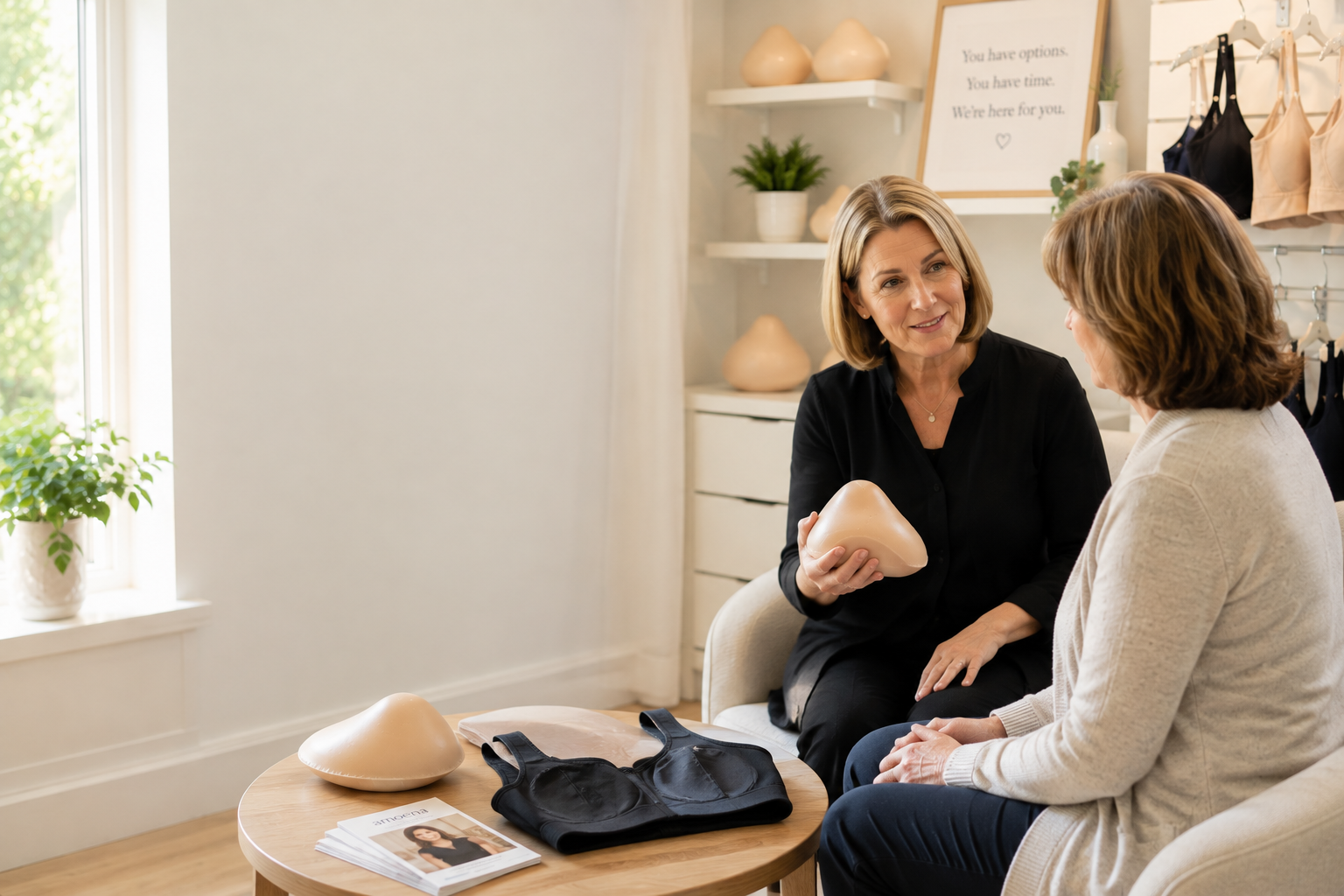
What Happens at the Permanent Prosthesis Fitting?
Once your healthcare provider is comfortable with your healing, the appointment should become less about surgery and more about fit.
Your fitter may take measurements and look at your chest-wall shape, remaining breast and overall proportions. Depending on the products available, you may try more than one shape, weight or projection.
- Then comes the part that cannot be done properly from a size chart:
- you compare them.
- One may look right but feel too heavy.
- One may feel comfortable but have more projection than you prefer.
- Another may work beautifully with one bra but not sit correctly inside another.
- A professional fitter's job is not simply to identify something that technically fits.
It is to help you understand why one option may work better for you than another.
Liberty Med's current services include private breast-health support, breast forms and prostheses, mastectomy and post-surgical bras, and certified fitting expertise at its Winnipeg location.
What Should You Bring?
You do not need to bring much, but the right items make the appointment more useful. Bring your prescription or healthcare instructions if you have them, your Manitoba program or private insurance information, the bra or temporary form you currently use, and one fitted shirt or sweater you know well. Most importantly, bring your questions.
- Tell the fitter what matters to you.
- If you want something lighter, say so.
- If symmetry matters most, say so.
- If you work long shifts and expect to wear the form all day, that matters.
- If you only want it for particular clothing or occasions, that matters too.
- The better the fitter understands your life, the more meaningful the fitting becomes.
Five Questions Worth Asking Before You Choose
Before making a final decision, ask:
- Why does this particular shape work for my chest wall?
- Can I compare another weight or projection?
- Which bras work best with this form?
- How should I clean and store it?
- What changes would mean I should come back and have the fit checked?
Those questions do something important.
They move the appointment from “Which product am I buying?” to “Do I understand why this product works for me?”
That is a much better standard.
What If You Reach 8 or 12 Weeks and Still Do Not Feel Ready?
Then you may not be ready.
The timeline is guidance—not a test you have failed.
CancerCare Manitoba specifically advises people to speak with their surgeon or healthcare provider when they are uncertain whether the surgery site has healed enough for a prosthesis and bra.
- Healing after breast surgery is individual.
- Additional treatment can influence it.
- So can swelling, skin condition, complications, reconstruction and your own comfort.
- There is no prize for getting a permanent prosthesis as quickly as possible.
- There is far more value in getting one when your body is ready to be fitted properly.
Breast Prosthesis Fittings in Winnipeg
Liberty Athletic + Medical Supplies provides breast-health and cancer-care fitting support in Winnipeg, including breast forms, prostheses, mastectomy bras and post-surgical garments. Liberty's current team information also identifies certified breast-form and mastectomy-bra fitting expertise.
Liberty Athletic + Medical Supplies
264 Taché Avenue
Winnipeg, Manitoba R2H 1Z9
Phone: 204-272-9640
Hours: Monday–Friday, 10:00 a.m.–6:00 p.m.; Saturday, 10:00 a.m.–2:00 p.m.; Sunday closed.
Specialized fittings are best arranged in advance so the appropriate fitter and product options can be available.
Frequently Asked Questions
How soon after mastectomy can I get a permanent breast prosthesis?
The Canadian Cancer Society gives a general timeframe of approximately 8 to 12 weeks after surgery, allowing time for the incision to heal and swelling to decrease. Your own healthcare provider should determine whether you are ready.
Can I use a temporary form before then?
Yes. Soft, lightweight temporary forms can be used during healing when appropriate. CancerCare Manitoba and the Canadian Cancer Society both provide information about temporary breast puffs.
Does everyone need a breast prosthesis?
No. Some people choose a prosthesis, some choose reconstruction and others choose to remain flat. It is a personal decision.
What if only part of my breast was removed?
A partial breast form or shaper may be an option when breast-conserving surgery has created a difference in volume or contour.
Will a permanent prosthesis feel heavy?
It can initially feel heavier than a temporary form. Gradually increasing wear time may help you adjust, but persistent discomfort should be discussed with your fitter or healthcare provider as appropriate.
Does Manitoba help pay for breast prostheses?
Eligible Manitoba residents may receive assistance through the Manitoba Breast Prosthesis Program. A prescription and an Approved Retail Supplier are required, and benefit limits depend on the program option selected.
The Calendar Does Not Decide When You Are Ready
Eight weeks can be useful information.
So can twelve.
But neither number knows whether your swelling has settled, whether your incision has healed, how your chest wall has changed or whether you feel ready to take the next step.
That is why the best permanent breast-prosthesis fitting starts before anyone reaches for a measuring tape.
It starts with one question:
“Where are you in your recovery now?”
Once your healthcare team is comfortable with your healing, the conversation can move to the things a fitter is there to help with—shape, weight, projection, bras, clothing, comfort and personal preference.
The goal is not to make your body look the way somebody else thinks it should.
It is to give you enough information and enough choice to decide what feels right for you.
What Really Happens at a Mastectomy Bra Fitting? A Winnipeg Guide to Comfort, Confidence & Breast Forms